



Overview
Itinerary
You will arrive at Tribhuvan International Airport where you will be met by your representative at Swiss Nepal Family Trekking & Expedition and taken by private vehicle to your Deluxe Hotel where you can relax for the night. There will be a short orientation program in the evening at your hotel.
We will travel by land cruiser today to the village of Arughat Bazaar on the Budhi Gandaki River. Arughat is located at a low elevation, and tends to be rather warm in the spring and fall. We pass through interesting forests, cross the Akhu Khola (River) and then on to Arughat. This is the last village of any size, and it is a major bazaar for the people of this region. Any last minute items may be found here. You can find continental food, and we will spend the night in a lodge.
We begin our trek today as we move north to the village of Lapubesi. This is a pretty little village on a tributary of the Budhi Gandaki. We will be following the Budhi Gandaki upstream for the first part of this trek. We will spend the night at a local lodge. Trekking time is 5 – 6 hours.
The trek continues to follow along the Budhi Gandaki River. We will cross the river on a suspension bridge over river with its many rapids as it cuts a deeper and deeper canyon. Dobham is a delightful little village next to a narrow canyon with great views of the Ganesh Himal mountains. Trekking time is 5 – 6 hours.
We cross the Budhi Gandaki twice today on long suspension bridges. We will find ourselves climbing higher and higher as we trek upwards to the pretty little village of Philim. This will be the last village of any size as we prepare to enter Tsum Valley the next day. Philim sits high on a hill overlooking the Budhi Gandaki River. This is also one of the last places to get a bath before entering into Tsum Valley. Trekking time is 5 – 6 hours.
We are rising in elevation as we following along the Budhi Gandaki. From here, we will start seeing fewer and fewer villages while rising higher and higher above the river. We can watch eagles and hawks soar on thermals while spotting magnificent waterfalls as they fall over cliffs on their way to meet the river below. The river has become narrower. Once we reach the confluence of the Budhi Gandaki and Syar Rivers, we will follow the trail along the latter. This river drains Tsum Valley. Our destination is the little village of Lokpa, the first village of Tsum Valley. It is small, but has a nice lodge with good selection of Chinese goods at the connecting store. The owner has four beautiful daughters who cook, clean and will serve you with a smile. Trekking time is 6 – 7 hours.
While we officially entered the Tsum Valley area yesterday, today we will drop down and pass through the narrow gorge on the Syar River that marks the true entrance to this valley. For centuries, this entrance was often overlooked, which protected the valley from invaders. It is still a narrow trail, but there are new suspension bridges being constructed. The trail will rise high again as we make our way into the lower valley. We will climb upwards into the upper valley to reach the largest village in Tsum Valley, Chhokang Paro. Trekking time is 8 – 9 hours.
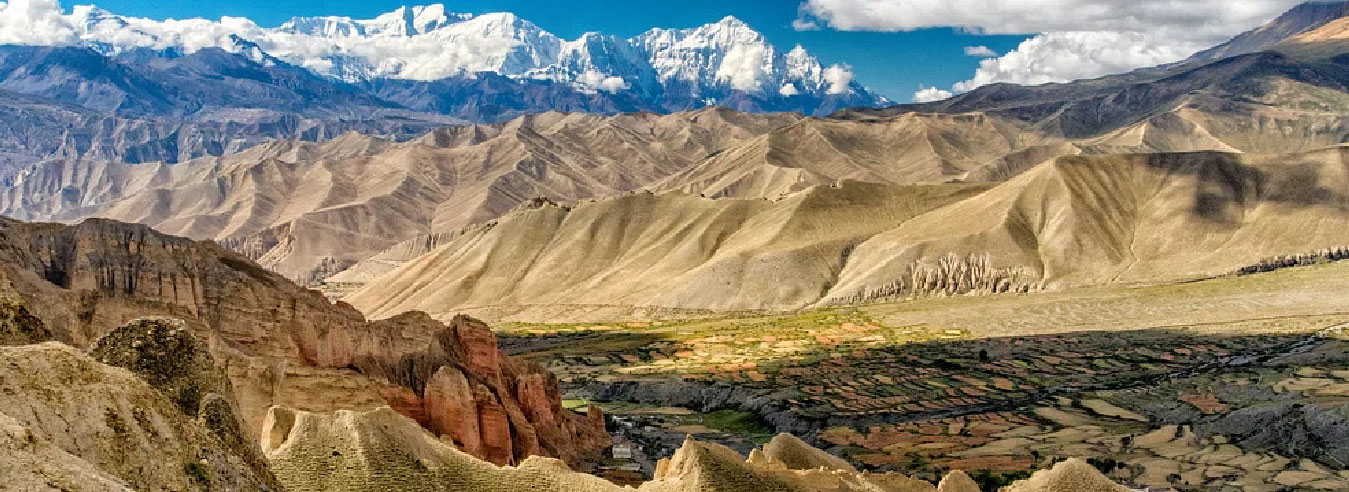
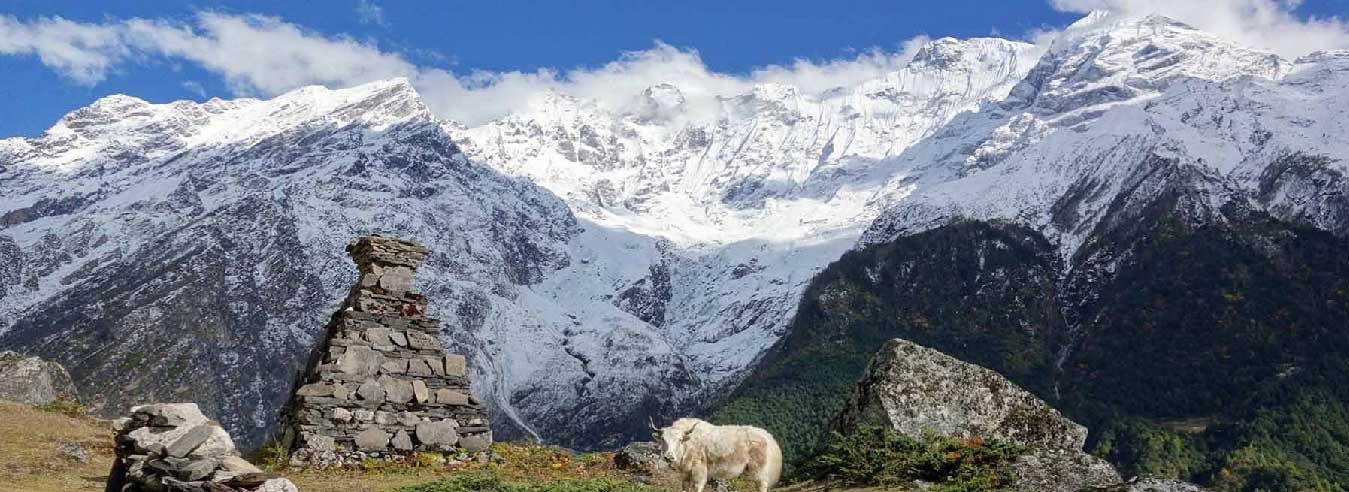
We are reaching some higher elevations today as we make our way upwards to the village of Nile. Here in the upper valley, we see great views of the mountains. The valley is very fertile, well watered by not only the Syar River, but the other streams that flow from the mountains. There will be time to stop at Piren Phu, a cave monastery with a great overlook of the valley. Inside is a footprint of St. Milarepa who meditated here for several months. We will pass yak herds along the way. Trekking time is 6 – 7 hours.
We make our way to the monastery of Mu Gompa. A large monastery, it has over 100 monks and it offers places for visitors to stay. There are great views of Tibet from here with all of the spectacular peaks to behold. We will return to a delightful little home stay at Lamagaon which is near Rachen Gompa, the largest nunnery in Tsum Valley. Trekking time is 7 – 8 hours.
We will return to the Lower Valley but take a side trip to another monastery at Gumba Lungdang. Here we have an incredible view of the Ganesh Himal Mountain Range with its incredible snow-capped peaks. From Domje to Gumba Lungdang there are no villages. We pass through rhododendron forests and along mountain streams. We will spend the night at this monastery which is open to travelers. Trekking time is 8 – 10 hours.
Today we can make a day trip to the Ganesh Himal Base Camp and back to Gumba Lungdang. It is quite a journey uphill as we follow along Torogumba glacier. There are no villages here, but there are a few kharkas (high mountain pastures). There are great views of the glacier and the mountains. Of course, you can still enjoy great views if you choose to stay at Gumba Lungdang and rest after a week of trekking in Tsum Valley.
We return to the lower Tsum Valley today as we make our way toward the entrance and one of our favorite places to stay here: the little village of Lokpa. The village is very small, but a great guest house, restaurant and local store. Trekking time is 8 – 9 hours.
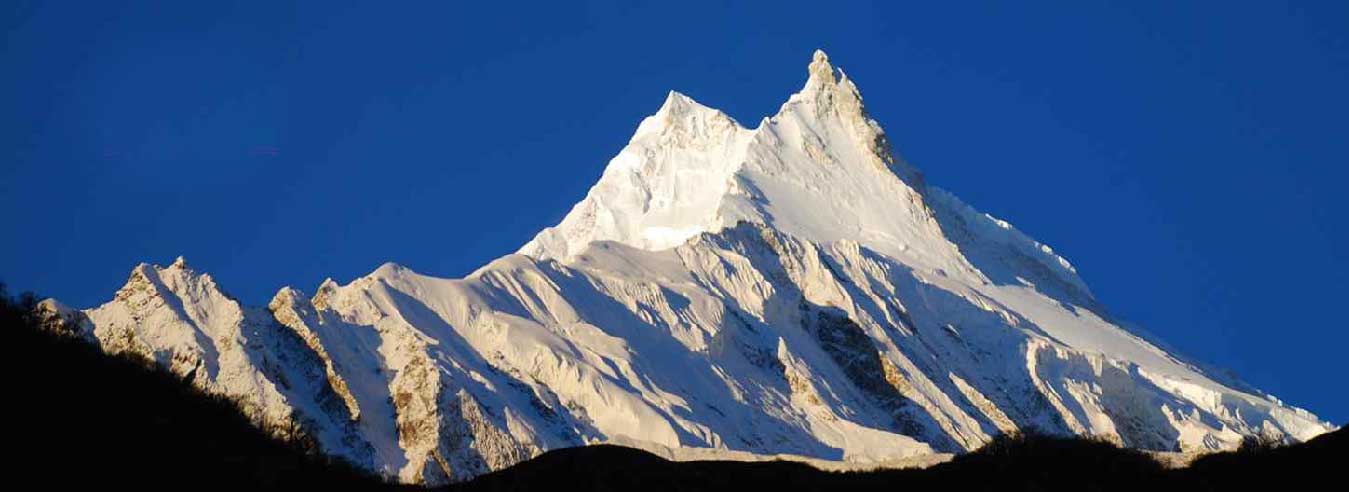
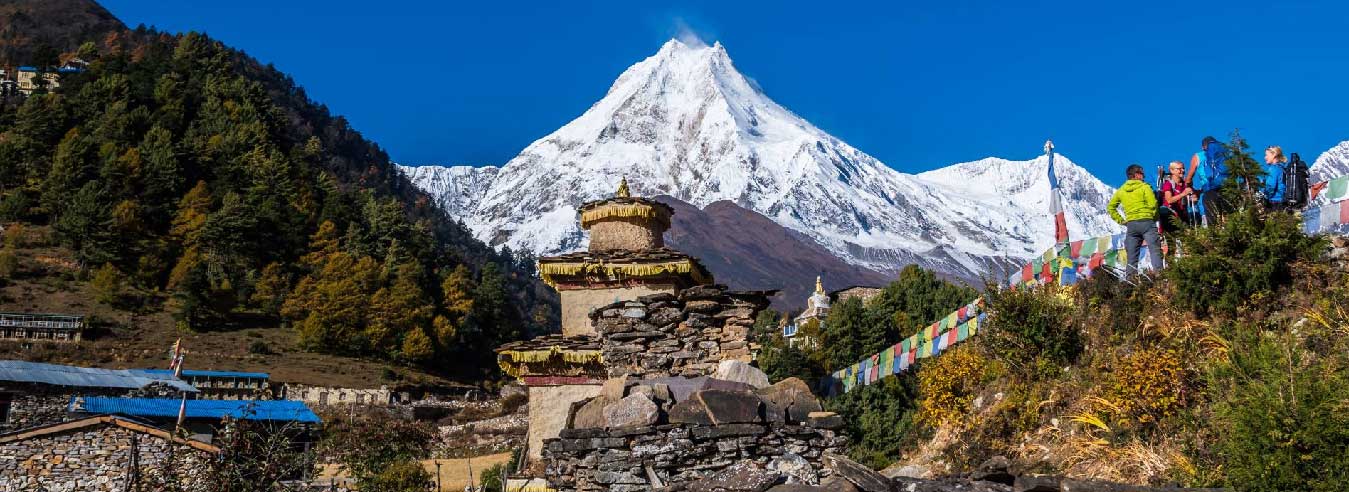
Today we leave Tsum Valley and now enter the Manaslu Conservation Area. It is a great trek as we pass through pine forests. We make our way down toward the Syar River, crossing it and once again meet our old friend the Budhi Gandaki River. Here we find some spectacular waterfalls as well as excellent views of Mt. Manaslu. We will cross the Budhi Gandaki River and then start the upward trail as we pass the village of Nyak and eventually reach Ghap. Trekking time is 8 – 9 hours.
Today is a day of climbing as we make our way to the village of Lho. The people here wear traditional Tibetan outfits as we pass through villages and terraced fields. In the middle of the fields are high platforms where people sleep to keep watch of their fields at night in order to chase out bears and other wild animals that threaten the crops here. Life is always on the edge in this place, so a bad harvest can mean starvation. We will pass through forests of oak, pine and rhododendron. We will stay overnight in a lodge at Lho, which will offer us great views of the Manaslu mountains. Trekking time is 5 – 6 hours.
We will be leaving behind some of the impressive views of Mt. Manaslu, but will see other impressive snowcapped peaks. This area is home to a variety of yak kharkas and small villages. Trekking time is 4 – 5 hours.
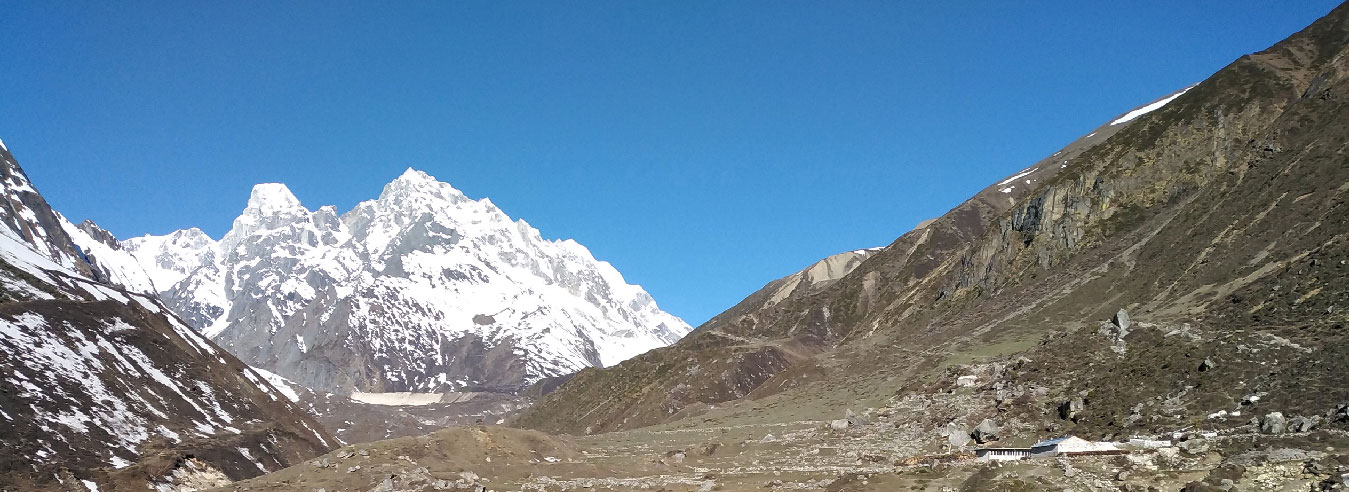
Today we move northward on the trail gaining elevation along the way. To our right, the snowcapped peaks we see are all on the Tibetan border. We will leave the tree line behind and instead see low juniper trees. The winds can be cold up here so it is good to have a good wind-breaker. We will spend the night at a local lodge. Trekking time is 4 – 5 hours.
The trail turns westward again as we make our way past mani walls and yak kharkas along the way. We will pass glaciers along with great overviews of snowcapped peaks. We will cross the Budhi Gandaki River, but it will hardly be recognizable. Here it is a small stream as it heads down the mountain. The views up here are incredible. We may stay in a stone hut if there is no snow. The hut has no doors, and can often be filled with snow. If it is, we will stay in a small tent for the night. Trekking time is 4 – 5 hours.
Today we reach the highest elevation of our trek at Larkya-La Pass. We walk beside the largest lateral moraine of Larke Glacier. The climb today is really not that difficult, although the trail is quite rocky underfoot. We will pass four frozen lakes until we finally reach Larkya-La Pass which is marked by prayer flags that flutter in the ever present breeze. From here, it is downhill to the village of Bimtang where we will find some good lodges to stay at. Going down is steep so it will take us some time. From Larkya-La Pass to Bimtang are great views, frozen glacial lakes along with glaciers and ice falls. We will spend the night at a local lodge. Trekking time is 8 – 10 hours.
We will climb up and down today, crossing the Bhimdang Glacier. We will climb up the moraine wall and enter some great forests. We will be able to see the backside of Mt. Manaslu today along with other snowcapped peaks. Dharapani offers the first village of any significance since we left Samdo. We will be entering the Marsyangdi Valley, crossing over the river on a long suspension bridge. We will stay in a local lodge. Trekking time is 8 – 10 hours.
The trek continues to climb as we pass through thick pine and fir forests. We will pass through several small villages with their whitewashed monasteries high above the people. Buddhists tend to build their monasteries on high places, better to be able to get away from the care and noise of life as they do their meditation. Along the way, there will be several excellent overviews where we can see Mt. Manaslu, Annapurna II and Peak 29. We will eat lunch on the trail, arriving at Koto village following a trek of 5 – 6 hours.
Today we enter the Naar-Phu Valley Restricted area. Your permit has already been taken care of by Vertical Adventures (P) LTD. One we pass the police check point, we follow along the river bank of the Suti Khola River in fragrant pine forests. There are numerous streams and suspension bridges we will be crossing. At the village of Dharmasala there is a picturesque waterfall where we will have lunch. From here, the trail becomes steep as we ascend to Meta Village where we will spend the night. Here we arrive on the Tibetan Plateau, which will offer incredible views of Annapurna II and Lamjung Himal. Trekking time is 6 – 7 hours, and we will stay in a local lodge.
Today you will really feel the isolation of the area as we will trek for around four hours and no see another human structure. Instead, we pass over suspension bridges well above rushing mountain streams. Along the way are remains of ancient forts and watchtowers. These were inhabited by refugees of the Khampa Kingdom who fled here and lived illegally. They built the watchtowers and fortresses in order to protect themselves from those they had fled from. That ancient kingdom is gone, so no need to fear any attacks from a dynasty that has long been committed to the pages of history. We finally reach Phu Khola, following the trail to Phu Village. We will probably see the famed Blue Sheep of the Himalayas today. We are now in the lost valleys and will come across some villages here. The people here are dependent upon subsistence agriculture, taking advantage of seasonal migration and animal breeding. The very oldest monastery in the area is on the agenda today: Tashi Lakhang Monastery. It is listed as one of the top 108 Great Buddhist Monasteries in the world and was the last one constructed by Karmapa Rinpoche. Along the way, there are great views of the Himlung Himal and other snowcapped peaks. We are above the tree line as we pass into these hidden and lost valleys. Trekking time is 6 – 7 hours, and we will spend the night in a local lodge.
The trail descends at first, crossing over many mountain streams until we arrive at the village of Mahendra Pul which takes around four hours. This will include crossing a suspension bridge 80 meters above the gorge of the Lapche River. We will stop for lunch at Mahendra Pul as well as rest a bit, because the next part of the trip will ascend upwards past Budddhist stupas until we reach Naar Village. At Naar, there is an excellent view of the snowcapped peak of Pisang as well as other smaller peaks. There are several monasteries to visit in and around this village. Trekking time is 6 – 7 hours. We will spend the night in a local lodge.
Today begins early as we have some major climbing to do. Today we reach the mountain pass of Kang-La high in the Tibetan plateau. We will see yak and yak herders along the way. From the mountain pass, there are incredible views of the mountains in a 360° panorama. There are numerous kharkas (grazing areas) along the way where the men will spend the summers with the animals. Today we will leave the restricted area after we leave Kang-La and make our way down the mountain to the village of Ngawal where we will spend the night in a local lodge. Trekking time is 6 – 7 hours.
Our goal today is the lovely mountain Gurung village of Manang. The trail today takes in some incredible mountain scenery as we can see clearly the snowcapped peaks of Annapurna I, II, III, IV, Tilicho Peak, Pasang Peak, Chulo Peak, Thorong Peak and many more. Our first village is Braga Village with its monastery and incredible views of the Annapurna Ranges. We will also have an opportunity to explore Cave Gompa after lunch. All along the way, we will be able to really appreciate the immense beauty of the Annapurna Ranges. Tonight, we will spend the night in a local lodge in Manang. Trekking time is 5 – 6 hours.
Manang is an impressive Gurung village. It is a large village and there is plenty to see and do. As we are climbing to higher elevations, it is necessary to allow our bodies to adjust to the higher altitudes in order to avoid altitude sickness. Today is a day of short hikes to help us acclimatize.. We will hike to Gangapurna Lake which will give us a close-up view of the Annapurna Mountains: Tilicho Peak, Pisang Peak, Chulo Peak, Thorong Peak and more. The morning will be for exploring around the lake, and then back to Manang in order to have lunch. Following lunch, we can hike to Cave Gompa (elev 4500 m) for one of the most impressive views of the Annapurna Mountains. We will spend one more night in Manang.
It’s a day of trekking as we get back on the trail and head for Khangsar Village where you can tour a monastery. The trail will descend slightly from this point until arriving at Thare Gompa to have lunch and to spend the night. Trekking time is 4 – 5 hours.
Our walk today is not all that physically demanding as we trek to Tilicho Base Camp. This is the place where climbers start for ascending this peak. We won’t be climbing the mountain, but we will be using this as our place to stay. Trekking time is 4 – 5 hours.
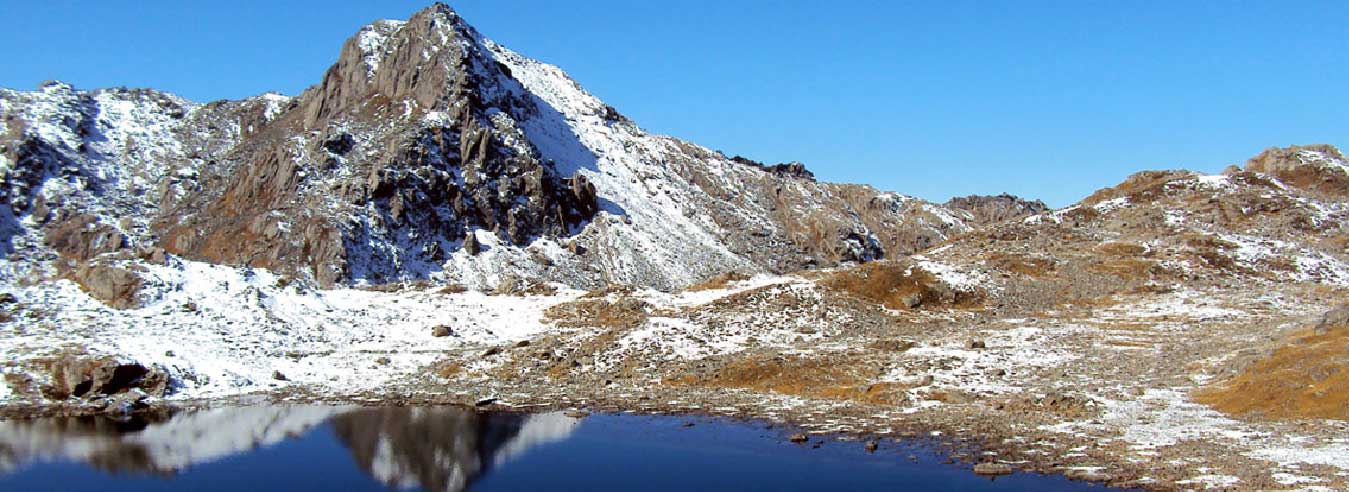
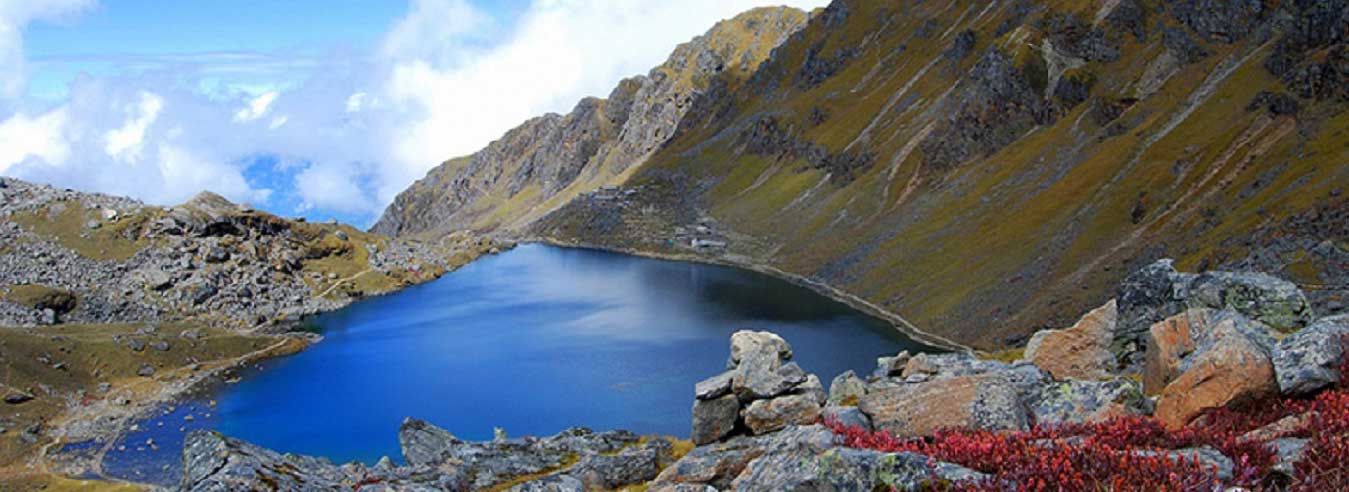
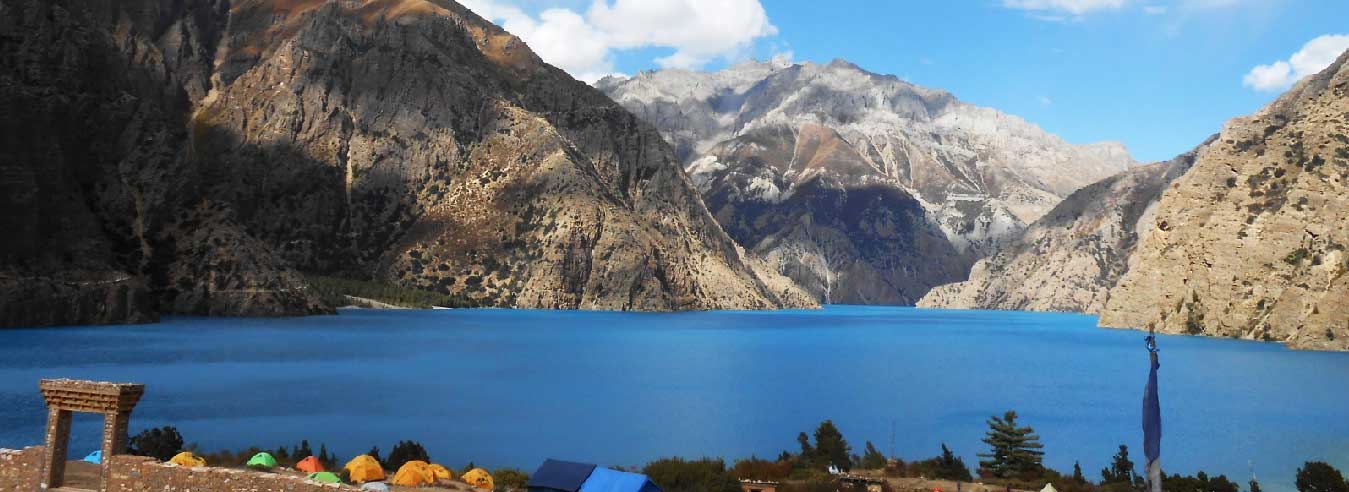
Tilicho Lake is one of those beautiful mountain lakes here in the Himalayas that reflect the incredible beauty of the snowcapped peaks. It is a bit of a climb to the lake which sits at 4920 meters above sea level. We will see plenty of wildlife along the trail as we make our way to and from this lake with its beautiful blue waters. We will have time to spend admiring the lake and the surrounding mountains. We will return to Tilicho Base Camp to spend a second night. Hiking time is around 3 – 4 hours.
It’s a return trip to Thare Gompa, passing by a large landslide area. We will have lunch and dinner in Thare Gompa, as well as spending the night in the village. Trekking time is 4 – 5 hours.
Our journey to Yak Kharka will return us back to the classic Annapurna trail. It is about four hours to Yak Kharka where we will spend the night. This is also a day to do some additional acclimatization. Trekking time 4 – 5 hours.
From Yak Kharka, we rejoin the better trail. We are climbing upwards to the village of Letder, which takes about one hour. The trail continues along the Kali Gandaki River. We cross the river on wooden bridges and then start a short, steep climb up to the village of Thorong Phedi where we will spend the night. Great views along the way of mountains and waterfalls. Trekking time is 4 – 5 hours.
It is a long day, but one that will take you to the highest trekking passes in all of Nepal. Thorong La Pass. It is a steep climb upwards to the pass, but what a view. It is worth the extra effort as you stand on what feels like the roof of the world and look out over the myriad of snowcapped peaks that will surround you. There is Tibet to the north, Manaslu in the east and Dhaulagiri to the west. And there are the close-up views of the peaks of the Annapurna Range. After spending a few hours at the top, your journey will begin a long descent to the village of Muktinath with its famous sacred temple that is a center of worship for Hindus and Buddhists as well as followers of the ancient Bön religion. The trek today is 7 – 8 hours and we will spend the night in a local lodge in Muktinath.
We won’t leave Muktinath until we have visited the sacred temple here with its ever burning flame. This flame has been lit for thousands of years and burns inside of the temple. Outside there are 108 brass water spouts and around the temple are a number of Buddhist monasteries. The trek continues downhill through impressive forests and scenic overlooks until we arrive at Kagbeni where we will spend the night. Trekking time is 4 – 5 hours.
Today is the last day of trekking as we make our way toward the ancient village of Jomsom. This village has been here on the main trail to Tibet where in ancient times black salt and gold passed southward while items from India were taken by traders to the north. Jomsom was once the capital of an ancient kingdom. Today it is a major entry point to the Annapurna Conservation Area and has a good airport. We fly tomorrow, but today we get trek to Jomsom and relax at our lodge for the night.
It is a short 45 minute flight from Jomsom to Pokhara. We take an early morning flight and upon landing in Pokhara, will check into our Deluxe Hotel. You can choose to relax today, or take in the sights in Pokhara. There is plenty to see and do in Pokhara. From boating on Phewa Lake to incredible mountain views and more, Pokhara is a favorite of all visitors to Nepal.
It is about a 6 – 7 hour trip back to Kathmandu. The trip is interesting as you follow fast flowing rivers, drive past terraced farms and see the deep river valleys. It is a beautiful journey as you return to the Kathmandu Valley. In the evening, enjoy farewell dinner at Paleti Bhanchha Ghar, an authentic Nepali restaurant.
All good things must come to an end, and your trip to Nepal is no exception. Before leaving, why not talk to your representative at Vertical Adventures (P) LTD about returning to Nepal for your next holiday. The vast majority of people make a return trip to Nepal because they are impressed by not only the beauty, but also the local people Vertical Adventures (P) LTD offers trips into neighboring Tibet, Bhutan and India. Be sure to discuss your interests and plans with them today.
Trip Information
Extras
IMPORTANT NOTE:
Your safety is of paramount importance while traveling with Vertical Adventures (P) LTD. Please note that your leader has the authority to amend or cancel any part of the itinerary if it is deemed necessary due to safety concerns. Every effort will be made to keep to the above itinerary. However, since this adventure entails travelling in remote mountain regions, we cannot guarantee that we will not be forced to make last minute changes due to weather conditions, health conditions or any member of the group, unexpected natural disasters, etc. The team leader will do everything possible to ensure that the trip runs according to plan. Be prepared for any last minute changes. The Himalayas are big and wild, and worthy of your respect.
TREKKING GROUP
For the Annapurna Circuit and Tilicho Lake Trek, there will be a trek leader and Sherpa Porters for carrying luggage (2 trekkers = 1 porter). This arrangement ensures that if anyone in the group is sick the trip can still go on as planned. However, Vertical Adventures (P) LTD can run this trek for groups of any size. Usually, we have found that the maximum number of trekkers in any group is 12 people.
ACCOMMODATIONS
All accommodations for the Manasulu and Annapurna Circuit are on twin-sharing basis. The lodges and tea houses have been selected by Vertical Adventures (P) LTD after personal inspection. We look at the conditions of the inns, local hygiene, quality of food, type of service and more.
We offer two types of accommodations on this trek. In Kathmandu you will stay Four nights at a Deluxe Hotel and one night in Pokhara. As there are no Deluxe Hotels available on the trek, you will spend fifteen nights in standard tea houses. These places have pleasant, unheated rooms and wooden beds with foam mattresses.
All rooms are double occupancy, but you can request a single occupancy room for an additional fee, which will be available only during the trekking. However, sometimes single rooms are not available in some places, depending upon local conditions. We do work to provide the best possible options when trekking in the High Himalayas.
MEALS
Food will vary between typical Nepali in the mountains. In Kathmandu and Pokhara, there are far more choices, which include Indian, Continental, Italian, Tibetan and more. The city areas offer everything from good steaks and burgers to apple pie and pizza.
Nepali food is nutritious, and ranges from our traditional dal/bhat and momo to fantastic breads, fruits and more. The cooking is wholesome and the food is tasty.
FAQS